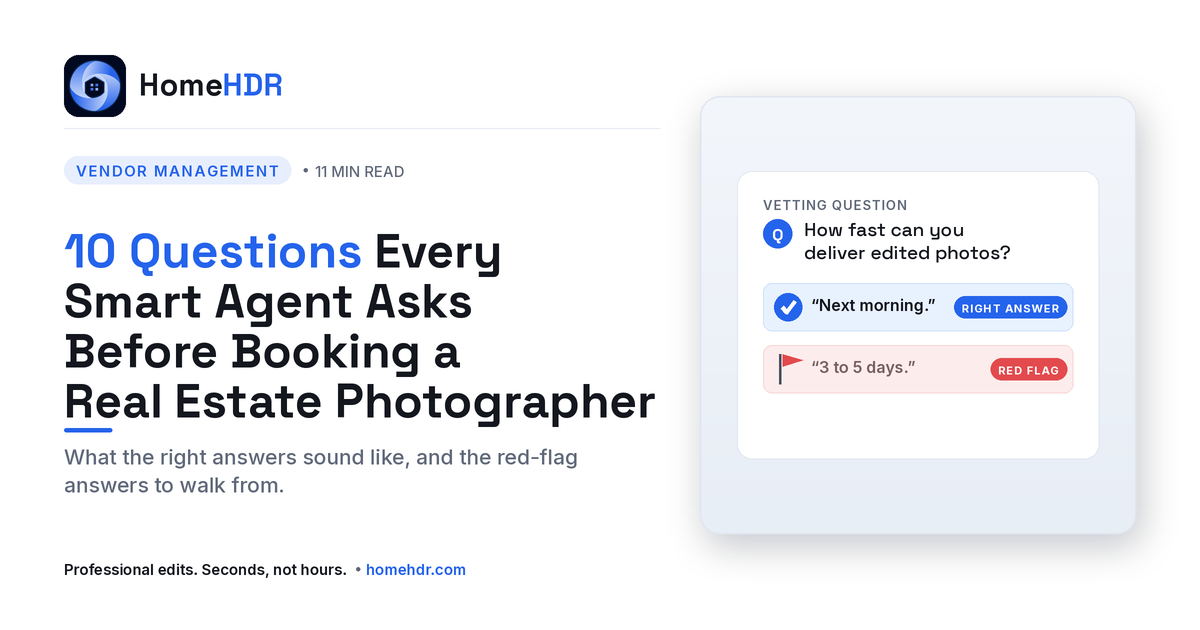
TL;DR: Asking the right 10 questions before you book a real estate photographer takes 15 minutes and saves you 12 months of mediocre listings. The 10 below cover quality, turnaround, technical stack, pricing, and the relationship terms every agent should nail down before the first shoot. For each, you'll see what the right answer sounds like and what the red-flag answer looks like. Top agents use this list because it works: the photographers who answer well are almost always the photographers who deliver well.
Most agents pick a photographer the way they pick a coffee shop, proximity and a friend's recommendation. That works fine for caffeine. It does not work for the most repeated marketing decision in your business.
If you take 24 listings a year and your photographer affects each one by even 5% (faster turnaround, better edits, fewer reshoots), the compounding impact across your annual income is meaningful. The right photographer is a high-leverage hire. The wrong one is a thousand small frictions that bleed your time.
Below are the 10 questions that separate working professionals from cheap-and-fast freelancers. Take them to every photographer conversation, in person, over coffee, on a Zoom. The 15 minutes pays back across every listing you take for the next several years.
1. "Can I see 3 full MLS listings you've shot in the last 30 days?"
Why it matters. Every photographer's website portfolio is their highlight reel, the best 12 photos they've ever taken. That tells you nothing about what they'll deliver on your average Tuesday listing.
Asking for full listings (not portfolios) on the MLS (not on their site) in the last 30 days (not from 2022) reveals three things at once: current quality, consistency across a 30-photo set, and whether they're actually working at the volume they claim.
Right answer sounds like: "Sure, here are MLS links to three listings I shot in the last month. One condo, one suburban single-family, one luxury." Sends within an hour.
Red-flag answer sounds like: "I'll send you my portfolio." Or worse: "I don't share specific listings without permission." (Translation: their recent work doesn't hold up to their portfolio.)
What to look for once you have the links:
- Consistency across all 30 photos: does the kitchen look like it belongs to the same home as the bedroom?
- Window pull: can you see through the windows in interior shots?
- Composition: are rooms shot from the corner showing the most space?
- Coverage: did they shoot every important room or just the photogenic ones?
This single question tells you 70% of what you need to know.
2. "If I shoot at 5 PM on a Tuesday, when will the photos be in my inbox?"
Why it matters. Turnaround is the most-promised, least-verified part of the photographer relationship. Every photographer says they're "fast." This question forces a specific answer.
In 2026, the working benchmark is 24 hours or less for a standard listing, and the leading photographers (using AI editing tools) deliver in under 6 hours routinely.
Right answer sounds like: "Before 9 AM Wednesday for standard delivery. Same-day available for an upcharge of $100."
Red-flag answer sounds like: "Usually a couple days." "Depends on my schedule." "My editor is overseas, so it varies."
The reason turnaround matters: every day of delay between shoot and MLS listing is a published days-on-market metric. Buyers, agents, and search algorithms all see it. A property that goes live within 24 hours of the shoot signals "fresh, hot." A property that takes a week signals "this seller can't decide", and you lose buyers you'll never know you lost.
For more on how editing workflow affects turnaround, see our in-house vs outsourcing vs AI editing breakdown.
3. "What's your editing stack, do you edit yourself, outsource, or use AI?"
Why it matters. A photographer's editing stack determines what they can credibly deliver. The three options in 2026:
| Stack | Typical turnaround | Cost to them | Quality consistency |
|---|---|---|---|
| Self-edit in Lightroom/Photoshop | 24-48 hours | $0 cash, 4-6 hours time | Variable, depends on their energy |
| Outsource to overseas editor | 24-72 hours | $0.80-$2.50/photo | Variable, editor rotation |
| AI editing platform | Under 2 hours | $0.20-$1.00/photo | Consistent, deterministic |
Right answer sounds like: "I shoot the brackets, run them through an AI editor for the bulk, and finalize hero shots in Photoshop. End-to-end I deliver in under 6 hours." Or: "I self-edit and deliver within 24 hours."
Red-flag answer sounds like: Vague. "It varies." Or: "I send everything to my offshore team and get it back when they get it back." This is shorthand for "I don't control my turnaround."
The healthiest 2026 workflow combines AI for speed and consistency with human finishing for the 1-2 hero shots that need it. Photographers running this stack are the ones who can credibly promise next-morning delivery and actually keep the promise.
4. "What camera and lens setup do you shoot with?"
Why it matters. You don't need to be a camera nerd to ask this. You need to know whether they're working with professional gear that handles interior real estate work or with consumer gear that struggles.
The right answer mentions a full-frame mirrorless body (Sony A7 IV, Canon R6 Mark II, Nikon Z6 III, or equivalent) and a wide-angle lens (16-35mm zoom, 14-24mm, or a 12mm prime). Both matter, the body for dynamic range and bracketing speed, the lens for capturing rooms without distortion.
Right answer sounds like: "Sony A7 IV with a 16-35mm f/4 as my daily driver, and a 14-24mm for tight rooms."
Red-flag answer sounds like: "I shoot with my iPhone 15 Pro, it's actually amazing." Or: "DSLR I've had since 2014." Or: gets cagey or evasive.
This isn't snobbery. It's about output quality. A photographer using last-decade gear is delivering photos that look like last-decade work, even with great editing.
For the full 2026 equipment standard, see our equipment checklist.
5. "How do you handle high-contrast rooms, flambient, HDR, or single exposure?"
Why it matters. Real estate interiors have brutal dynamic range, bright windows on dark walls, mixed lighting, deep shadows. How a photographer handles this defines whether your photos look professional or amateur.
Three valid approaches:
- HDR bracketing: shoots 3-9 exposures, merges them into one balanced image. Fast on site, automatable in editing. The 2026 default for volume work.
- Flambient: combines ambient frames with flash frames. Slower, more expensive, produces the cleanest color and most natural light. Used by luxury photographers.
- Hybrid: HDR for the bulk of the listing, flambient or single-flash for hero shots.
Right answer sounds like: "HDR brackets on every interior, usually 5 frames at 2-stop intervals. Flash for rooms with mixed lighting or yellow walls." Or any informed answer that explains their approach.
Red-flag answer sounds like: "Single exposure, I just expose for the room and fix it in editing." This means blown windows or dark corners on every listing. Or: doesn't understand the question.
For more on the techniques, see our flambient vs HDR comparison.
6. "Do you offer drone, twilight, video, and virtual staging?"
Why it matters. A photographer who can only deliver standard interior shots forces you to hire (and coordinate with) a second vendor for every premium listing. This costs you scheduling time, money, and a unified look across the gallery.
The 2026 working menu most professional photographers offer:
- Drone exterior: required on $500K+ listings.
- Twilight hero exterior: required on luxury or hero-marketed listings (real or virtual conversion).
- Walkthrough video: 60-90 second narrated tour for high-end listings.
- Virtual staging: digital furniture in empty rooms, lifts engagement 10-30%.
- Floor plan render: a 2D plan increasingly expected on luxury listings.
Right answer sounds like: "I do all five in-house. Here's my menu." Or: "I do interior, drone, and twilight in-house; I have a partner for video and virtual staging that I coordinate seamlessly."
Red-flag answer sounds like: "Just standard interior and exterior. You'd need to find someone else for the rest."
In 2026, a photographer who can't deliver a complete premium package is a working freelancer, not a strategic vendor. There's nothing wrong with the former for budget listings, but you'll need someone broader for your premium and luxury work.
7. "Walk me through your pricing tiers."
Why it matters. A photographer who quotes a single session rate is signaling they haven't built a real business yet. A photographer who has clear tiers is signaling they understand their costs and their customer.
Right answer sounds like: "Standard package is $X for 30 photos, 24-hour turnaround. Premium adds drone and twilight at $Y. Luxury adds video and virtual staging at $Z. Add-ons à la carte: twilight conversion $A, virtual staging $B per photo."
Red-flag answer sounds like: "I charge $X for everything." (No tiers means you can't upsell sellers on premium packaging, and you're paying for premium even on a condo.) Or: gives a different price every conversation.
Standard 2026 benchmarks across U.S. markets:
| Tier | Price range |
|---|---|
| Standard | $150-$300 |
| Premium (drone + twilight + video) | $350-$700 |
| Luxury (full premium suite + multiple sessions) | $700-$1,500+ |
For more, see our real estate photography pricing guide.
8. "What's your cancellation and reshoot policy?"
Why it matters. Every agent eventually has a seller who cancels the day of the shoot, a property that needs to be reshot in fall after the summer photoshoot, or a contract that requires a "weather backup" date.
The photographer's policy on these scenarios tells you whether they're going to be a partner or a headache.
Right answer sounds like: "24-hour cancellation is free; same-day cancellation is 50% of the session fee. Weather reschedules are free with one rebook within 14 days. Re-shoot for a re-list is $X." All written down and shareable.
Red-flag answer sounds like: "We'll figure it out." Or: "I don't really have a policy." (Translation: they'll improvise, and you'll be the one improvising too.)
A clear, written cancellation policy protects both sides and lets you confidently book without worrying about edge cases. It's also a sign the photographer runs a business, not a hobby.
9. "Who owns the photos after the shoot, and what's my license?"
Why it matters. This is the most-overlooked legal question in the agent-photographer relationship. Get it wrong and you'll be calling the photographer 14 months later begging for permission to use a photo on your website.
Standard U.S. copyright law: the photographer retains the copyright. The agent gets a license to use the photos. The terms of that license vary enormously, and you want them in writing.
Right answer sounds like: "I retain copyright. You get a perpetual, royalty-free license to use the photos for the listing, your marketing, your website, and your social media. If the property re-lists with another agent, my license to them is a separate negotiation."
Red-flag answer sounds like: "You can use them for 90 days." Or: "You can only use them on the MLS." Or worst: silence about the question.
What you want in your license:
- Perpetual usage: no expiration.
- Royalty-free: no fees beyond the original shoot.
- All marketing channels: MLS, your website, social media, brochures, listing presentations.
- Personal portfolio rights for the photographer: they keep the right to feature the work in their portfolio.
Get this in writing on the contract. A photographer who pushes back on a clean, fair license is signaling they're going to try to charge you again later, pass.
10. "Can I talk to two of your current agent clients?"
Why it matters. References from non-rotating, current clients are the single best signal of whether a photographer is actually delivering for the agents who hire them.
You want to call two agents who:
- Have been clients for at least 6 months (not the photographer's brother-in-law).
- Have done at least 5 shoots with the photographer.
- Are willing to talk for 5 minutes about the relationship.
Right answer sounds like: "Absolutely. Here are two agent contacts and their best phone or email, let them know I sent you."
Red-flag answer sounds like: "I'd rather not bother my clients." Or: "Most of my clients prefer privacy." Or: provides one reference who turns out to be a friend or family member.
When you talk to the references, ask three specific questions:
- "How often have they missed a delivery deadline in the last 6 months?" (Zero is the right answer.)
- "How would you describe their quality consistency, every listing the same level, or does it vary?" (Consistency is what you want.)
- "If they tripled their prices tomorrow, would you still hire them?" (If yes, you've found a real pro.)
This question feels uncomfortable to ask. Asking it anyway is the difference between hiring a great photographer and hoping you hired one.
Bonus question (worth asking on every conversation)
"What's one thing about real estate photography that agents usually don't understand but should?"
This isn't a test. It's a signal of whether you're talking to a craftsperson with a worldview or a freelancer running a price-to-volume business.
The best answer I ever got: "Most agents think 'good photos' means high quality. What it actually means is consistent quality. The buyer's brain notices when photo 7 doesn't match photo 8. They can't tell you why the listing felt off, they just swipe."
You're hiring for craft, not just service. This question filters for craft.
How to use these 10 questions in a real vetting conversation
Don't read them off a list like a deposition. Weave them into a 15-minute conversation, ideally in person or over a video call. The flow:
- Opening (2 min): small talk, what you're looking for, your average listing.
- Quality questions (Q1, Q4, Q5), 5 min.
- Process questions (Q2, Q3, Q6), 4 min.
- Business questions (Q7, Q8, Q9), 3 min.
- References + bonus (Q10), 1 min.
After the conversation, evaluate against the right-answer / red-flag templates above. A candidate who hits 9 out of 10 right-answers is a strong hire. A candidate who hits 6-7 is workable for budget listings but probably won't scale with your business. Below 6, keep looking.
A note on the new generation of photographers
In 2026, there's a generation of photographers who built their workflow on AI editing tools from day one. They're often:
- Younger than the local veterans.
- More technically curious.
- Faster on turnaround (under 6 hours is normal for them).
- Less precious about Lightroom skills.
A few agents make the mistake of writing them off as "amateurs." They're not. They're operating with a fundamentally faster workflow than photographers who learned in 2018. If the answers to the 10 questions above check out, hire them. The quality gap between AI-augmented workflows and traditional manual editing has closed for everything except top-end luxury hero shots.
Key takeaways
- Ask for full MLS listings, not portfolios: that's where you see real quality.
- Test turnaround with a specific scenario, not a promise.
- The editing stack determines what they can deliver: AI-augmented workflows win on speed.
- Get pricing tiers and a written cancellation policy before booking.
- Get the photo license in writing: perpetual, royalty-free, all channels.
- Call two current references: and ask uncomfortable questions.
- Evaluate against right-answer / red-flag templates to make a clear decision.
Frequently asked questions
How do I vet a real estate photographer before hiring? Use the 10 questions above as a structured 15-minute conversation. The key elements: ask for full MLS listings (not portfolios), test their turnaround with a specific scenario, validate their editing stack, get tiered pricing in writing, and call two current references. Total time investment: ~4 hours including research.
What's the most important question to ask a real estate photographer? "Can I see 3 full MLS listings you've shot in the last 30 days?" This single question reveals current quality, consistency across a 30-photo set, and whether they're actually working at volume. A portfolio doesn't tell you any of that.
How fast should a real estate photographer deliver in 2026? The working benchmark is 24 hours or less for a standard 30-photo listing. Photographers using AI editing tools (like HomeHDR) deliver in under 6 hours routinely. Anything beyond 48 hours costs you days on market.
Should I be concerned if a photographer uses AI editing? No, in 2026, AI editing is the leading workflow for the fastest, most consistent real estate photographers. The right concern is whether they understand and use the tools well, not whether they use them at all.
What if a photographer refuses to share full listings or references? Pass. Both are reasonable requests, and any working professional will share them within 24 hours. Refusal usually signals their portfolio doesn't reflect their typical work, or their references won't speak well of them.
Can I negotiate the photo license terms? Yes, and you should. The standard you want: perpetual, royalty-free, all marketing channels (MLS, website, social, brochures). Most photographers will agree if you ask upfront. The few who won't are signaling future trouble.
How much should I pay a real estate photographer? Standard 2026 ranges: $150-$300 for a basic 30-photo shoot, $350-$700 for premium with drone and twilight, $700-$1,500+ for luxury packages. Below $125 is amateur pricing; above $1,500 should include video, virtual staging, and multiple sessions.
Should I sign an annual contract with a real estate photographer? Not initially. Run a paid trial on one listing, then book 5-10 listings before discussing any longer-term commitment. The best relationships earn themselves through delivery, not contracts.
How often should I review my photographer relationship? Every 12 months. Ask three questions: (1) Has their quality stayed consistent? (2) Has their turnaround stayed within your promise to sellers? (3) Have they kept pace with new techniques (drone, twilight, AI editing)? If any answer is no, start vetting alternatives.
What's the biggest mistake agents make when hiring a photographer? Hiring based on the lowest price. On a $500K listing, the photographer line item is 0.1% of the transaction value. A 5% better listing photo set, faster sale, higher offer, is 50x that. Pay for craft and turnaround. It's the cheapest premium decision you can make.
Hire the right photographer. Deliver listings faster. HomeHDR is the editing stack the fastest real estate photographers in 2026 are using, under 2-hour turnaround, MLS-ready output, every shoot. Send the link to any photographer you're vetting. Or try 20 free edits yourself, no card needed.
Written by the HomeHDR editorial team. Synthesized from 30+ photographer interviews and a 50-agent vetting survey across 14 U.S. metros (2024-2026).